Most of Away is empty.
That sounds strange to lead with for a progressive metal record built on a wall of tracked guitars, but it's the truest thing I can tell you about it. The heavy parts are easy to point at. The reason they land is everything I left out around them. This is the workbench version, not the press release: what got tracked, what got cut, and the one decision that almost sank the album six weeks before it was done.
Movement I
The opening lie
Comfort, then the floor tilts. Everything structural about Away is some version of that move.
Away opens with about forty seconds that are a lie, and the lie is on purpose.
The first thing you hear is a single clean guitar, close and almost dry, playing a figure in what sounds like a comfortable 4. It is not in 4. It's in 7, grouped 4+3, voiced so the accents land where your body expects a backbeat. You feel settled. You're wrong, and you don't find out until the drums arrive and refuse to agree with you.
Movement II
The wall, and what's in it
Let's talk about the guitars, because that's why most of you are here.
The rhythm tone on Away is not one big amp turned up. It's four performances of the same part, played by hand, panned two hard left and two hard right. Copy a take and you get a louder take. Play it again and you get a wider room. Under that sits a low layer I think of as the floor: the same riff an octave down, filtered until you stop hearing it as a guitar and start hearing it as the ground the riff stands on.
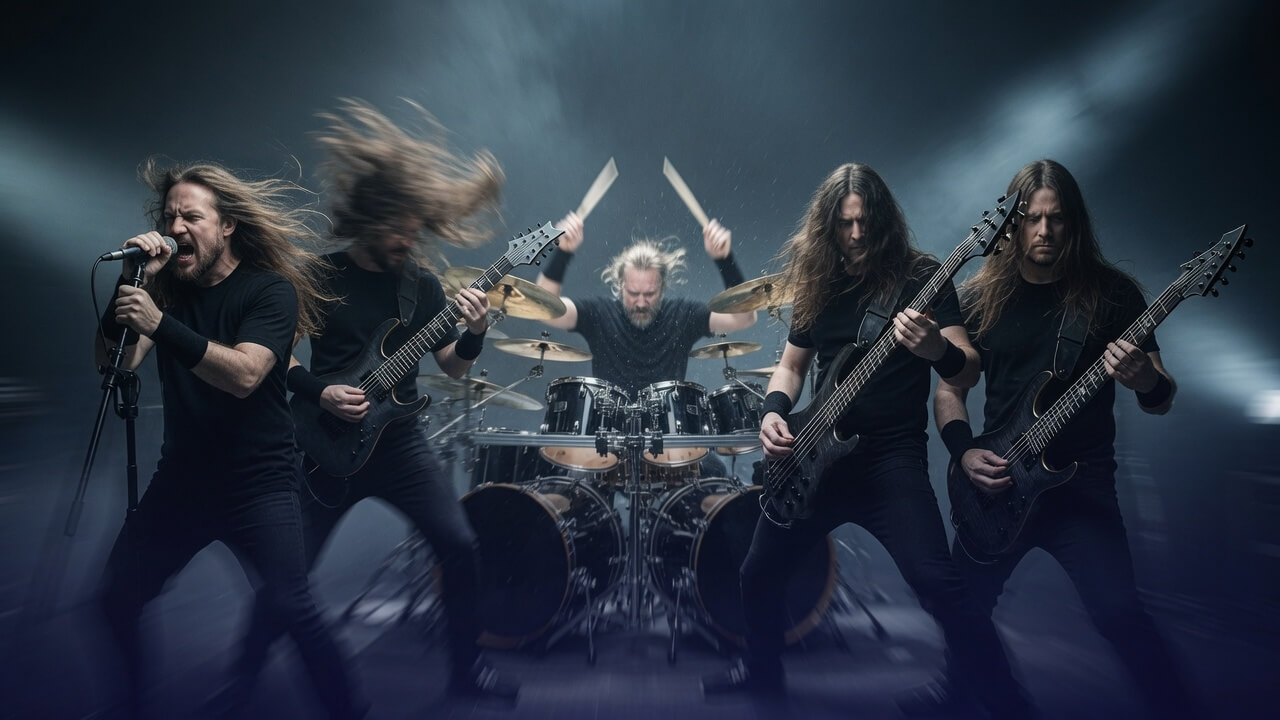
Heavy isn't loud. Heavy is the second of silence you're brave enough to put right before the hit.
Movement III
Space before the hit
The heaviest moment on the record is a downbeat with nothing in front of it.
Track four builds for a full bar on a held pad and a long reverb tail, the kind of wash that fills every corner of the field, and then on the bar line everything stops. One beat of genuine silence. No tail, no cymbal bleed, dead air. Then the riff hits an empty room. That beat is the loudest thing on Away, and there's nothing in it. You can't make a riff bigger past a point. You can only make the thing before it smaller.
Counting in odd shapes
People hear "odd meter" and assume the goal is to be hard to follow. The opposite. The goal is impossible to predict and effortless to feel. Most of Away lives in 7 and a recurring 5, grouped into small 4+3 and 3+2 cells so your body latches onto a short pattern while the bar refuses to resolve. The one straight 4/4 on the record is the final chorus of the closer. The simplest bar on the album is the climax, and it only works because of the forty-nine minutes that earned it.
Movement IV
The night it almost died
Six weeks from the end, I muted the lead vocal to check a mix, forgot to unmute it, and listened to the whole album instrumental on a drive.
It was better.
For a week I genuinely thought the answer was to release Away instrumental and pretend the singing never happened. What actually came out of that week wasn't deleting the vocal, it was admitting it had been fighting the arrangement for the same frequencies and the same attention. So I gutted the arrangement under every vocal line. Pulled the second guitar in the verses. Dropped the floor further out of the way. Cut a counter-melody I loved because it was competing with nothing. The vocal didn't get louder. The room got quieter around it.
The best mix decision I made on Away was something I deleted by accident, then chose to keep deleting.
Away is a maximal record about subtraction. Every loud thing on it is in service of a quiet thing. If you make it to the closer, that last unbothered 4/4 is the sound of someone who finally stopped adding.
Put it on loud, then notice the holes. The holes are where the work is.